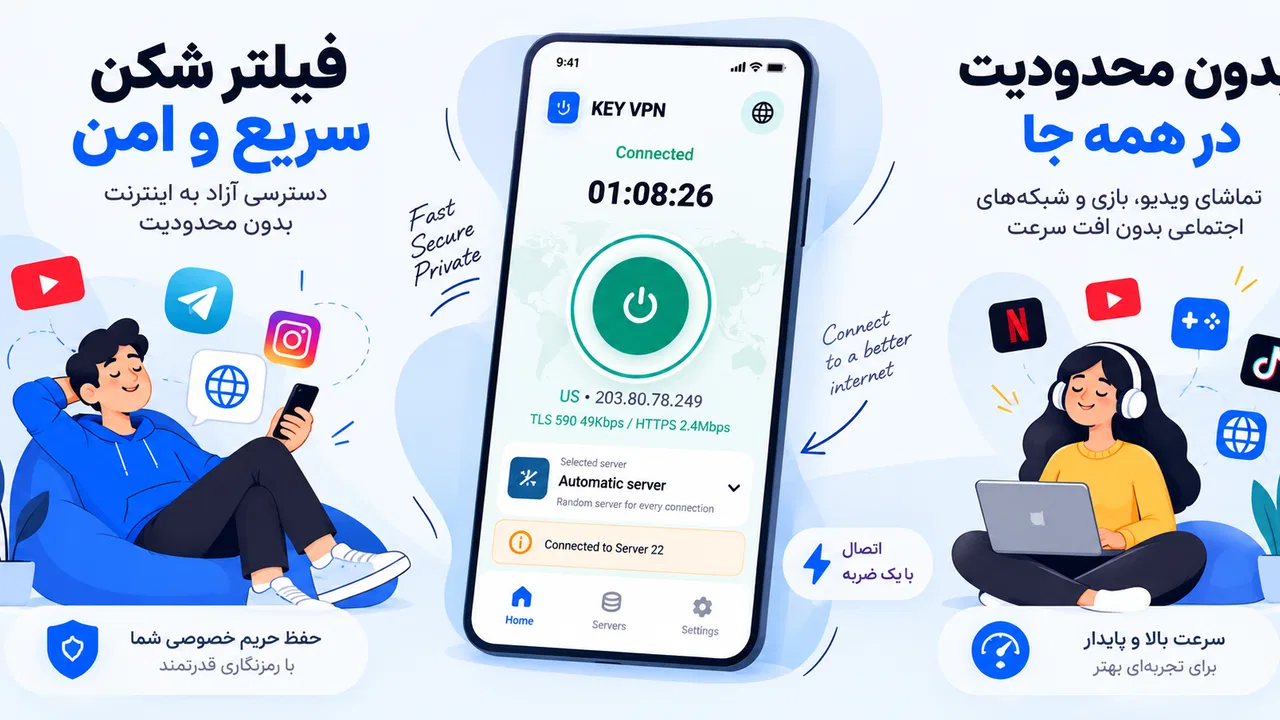
Key VPN–Secure VPN
- 4.6
- Rating
- 10.00M
- Installs
- Free
- Price

 Analysis by App-foxy
I tested Key VPN–Secure VPN as a communication app rather than treating it like a complicated networking tool. Its purpose is straightforward: it is designed to help protect browsing and data when a connection feels exposed, especially on public Wi-Fi. That makes it relevant in cafés, hotels, airports, libraries, shared offices, and anywhere I would hesitate to enter personal information on an unfamiliar network.
The app comes from Azadi vpn and is free to use. It is rated for Everyone, works on Android devices running version 6.0 or later, and the current release is version 16.0. Its popularity is notable too: it has passed five million installs, with an average rating of 4.7 from around eighty-one thousand ratings and roughly one thousand four hundred written reviews. Those figures do not replace personal testing, but they do suggest that many people find the basic experience approachable.
My main focus was not simply whether it could be connected. I looked at how understandable the experience feels, how much effort it demands from someone with different motor or sensory needs, and whether it remains useful when a person is tired, distracted, travelling, or working with an unreliable connection. The strongest part of Key VPN is its low barrier to starting a safer browsing habit. Its weaker side is that a simple interface can leave advanced users wanting more explanation and control.
You May Also Like

 Blood Strike: 2.5 Anniversary
Blood Strike’s Loadouts Turn Every Drop Into a Tactical Gamble
A close look at Blood Strike’s custom loadouts: how fast access to signature weapons reshapes its battle royale rhythm, rewards preparation, and narrows the gap between fights.

 Pandora - Music & Podcasts
Pandora’s Music Is Easy to Start, but Harder to Recover
Pandora’s strength is its low-effort path from a seed to a station. Its weak spot is how much confidence it asks you to place in connection, setup, and quiet recovery.

 8 Ball Pool
 Is Built on Rivalries, Rematches, and Routine
A close look at the rivalries, rematches, shared routines, and unanswered safety questions that turn a quick pool match into a persistent mobile community.

 Samsung Music
’s Quiet Strength Is Playing What You Already Own
Its reach comes less from spectacle than from dependable access to a personal library. That simplicity is both the app’s strongest retention engine and its ceiling.

 AccuWeather: Weather Radar
AccuWeather Review: A Quick, Clear Forecast for Everyday Decisions
For everyday plans, the best forecast is the one you can understand quickly. AccuWeather makes rain timing, radar, and local conditions easy to act on, with a few trade-offs.

 Hill Climb Racing
Why Hill Climb Racing Still Turns Crashes Into One More Run
A tiny car, a bumpy hill and one more upgrade: Hill Climb Racing keeps resurfacing because its simple chaos makes every near-miss feel personal.
More From Our News Desk



How the interface feels when readability matters
Key VPN benefits from having a narrow purpose. I did not have to work through a crowded communication dashboard, a messaging inbox, or a long list of unrelated tools. The experience is centered on the VPN task, which makes it easier to understand why the app is open and what I am expected to do next. For someone who finds dense settings screens tiring, that focus is valuable.
The app is especially suitable for people who prefer a direct visual path: open the app, identify the connection control, and decide whether to continue browsing. That kind of structure reduces the memory burden compared with tools that expose many technical choices immediately. A first-time user does not need to understand every networking term before trying the basic protection offered by the app.
At the same time, simplicity should not be confused with complete transparency. A person who wants to know exactly how the connection is configured, what location is being used, or which advanced behavior is active may feel that a streamlined VPN app does not answer every question at a glance. I would advise cautious users to read the visible labels carefully rather than assuming that a connected state explains every detail about privacy.
For readers who enlarge text or rely on strong contrast, the practical question is whether the important controls remain easy to identify at the device level. Android’s own display settings can help, but enlarged text may change the layout of any app. I would test the main connection flow before relying on Key VPN for travel or work. The app’s focused purpose helps, yet a clean design is not a guarantee that every display preference will behave perfectly on every phone.
Navigation is most comfortable when I am doing one thing at a time. I can see the appeal for an older user who wants protection on hotel Wi-Fi without learning the vocabulary of virtual private networks. It also suits someone who becomes overwhelmed by a long settings menu. In contrast, a network administrator, privacy enthusiast, or person managing several specialized connection rules may prefer a more configurable VPN product.
Why a simple connection flow can help beginners
One useful, non-obvious advantage is the reduction in decision fatigue. Many people postpone using a VPN because they expect to choose protocols, servers, or complicated preferences. Key VPN’s focused presentation makes it easier to turn protection into a repeatable step before opening a browser or an app that handles sensitive information.
I found that this is most useful when the routine is attached to a specific situation. For example, I would open the app after joining a café network, check the connection state, and only then sign in to an account or send a work message. The value is not just technical; it is behavioral. A tool that takes less mental effort is more likely to be used consistently.
There is a trade-off, though. A beginner may interpret a prominent connection state as a complete privacy guarantee. I would still use secure website connections, strong account passwords, and multi-factor authentication where available. A VPN can protect the network path in useful situations, but it does not make careless links, unsafe downloads, or poor account security harmless.
Motor and sensory considerations during everyday use
Key VPN can be a sensible choice for someone who has difficulty with precise tapping, provided the main controls are comfortably sized on their particular device. A focused VPN screen is generally less demanding than a crowded utility with tiny icons scattered across several panels. I would use the phone’s accessibility settings to increase touch targets where possible and avoid rushing through the connection step.
For users with limited hand movement or tremor, the most practical workflow is to prepare before the connection becomes urgent. I would open the app while stationary, connect before starting a journey, and avoid trying to manage it while walking through a station. This is a small adjustment, but it reduces the need for repeated taps and lowers the chance of accidentally selecting the wrong control.
Voice control and switch access depend heavily on the Android device and the way the operating system exposes controls inside the app. I would not promise that every action is equally convenient through assistive input. The app’s limited scope is encouraging, but people who rely on a specific input method should try the complete process on their own phone before making it their only protection tool.
Sensory load is another area where the focused design helps. A VPN app does not need to compete with message alerts, feeds, or animated content. That can make it less distracting for people who are sensitive to visual clutter. The connection task can be treated as a short checkpoint rather than a place where the user must browse through multiple layers of information.
However, visual simplicity can create a different problem for users who need strong confirmation. If a person cannot easily distinguish subtle color changes or small status text, a connection indicator may not be enough. I would look for a clear textual state and verify that the device’s accessibility features can read the important information. If confirmation remains ambiguous, I would avoid assuming the VPN is active and would not use an unsecured network for sensitive activity until the status is clear.
A safer routine for people who are easily distracted
One of my preferred workflows is to make Key VPN part of a short arrival routine: connect to the public network, open the VPN, wait for a clear active state, and only then begin browsing. This is useful for people who lose track of steps when travelling or switching between tasks. It also helps users who may not notice a network change after moving from home to a public location.
Another practical tip is to keep the app available in a familiar place on the phone rather than searching for it under pressure. That matters for users with cognitive fatigue, low vision, or limited dexterity. The fewer decisions required during a busy moment, the more reliable the routine becomes.
I would also avoid repeatedly tapping the connection control if the response is not immediate. Repeated taps can create uncertainty about whether the app is connecting, disconnecting, or simply processing a request. Waiting for a definite state is safer than treating every tap as confirmation. If the connection does not behave as expected, I would move to a trusted network instead of continuing sensitive work while guessing.
Situational access: where the app fits best
Key VPN makes the most sense for people who regularly use public Wi-Fi and want a simple protective layer without paying for an app. A student working in different study spaces, a traveller checking reservations at a hotel, or a freelancer sending files from a shared workspace can all benefit from a quick connection routine. The free price removes one common obstacle for users who cannot justify another monthly service.
A realistic example is a person waiting at an airport with a low battery, a bright screen, background announcements, and limited time. They may not have the patience to compare technical settings. Opening a focused VPN app, checking its state, and then reading email is more realistic than configuring a complex network tool. In that situation, ease of recognition matters as much as the underlying purpose.
The app can also help households with mixed technical confidence. One family member may understand VPN terminology while another only wants a clear way to reduce exposure on public networks. A narrow interface gives the less technical user a better chance of completing the basic task independently, which is important for dignity and practical access.
It is less convincing as a complete answer for people who need a VPN for demanding professional work. If you need detailed server selection, fine-grained routing, extensive connection diagnostics, or a thoroughly documented privacy workflow, a more established specialist service may be a better fit. Key VPN’s appeal is convenience, not an obvious abundance of expert controls.
Users should also think about the context in which they need access. A VPN may help when the local network is untrusted, but it cannot solve every connectivity problem. If the public Wi-Fi itself is slow, unstable, or blocking certain traffic, adding a VPN can make the experience feel less predictable. For a short, non-sensitive task, mobile data or a trusted personal hotspot may be the simpler alternative.
How it compares with usual alternatives
Compared with browsing without a VPN on public Wi-Fi, Key VPN offers a more deliberate safety step. The important difference is behavioral: instead of hoping the network is trustworthy, I can choose to establish the VPN connection before handling private activity. That does not remove every online risk, but it is a meaningful improvement over ignoring the network entirely.
Compared with a paid VPN from a large specialist provider, the likely advantage here is accessibility in the everyday sense: free entry, a focused purpose, and less pressure to understand advanced options. The likely disadvantage is that users seeking a broad set of documented controls may find the experience too limited. I would choose Key VPN for uncomplicated public-network use and investigate alternatives for professional privacy requirements.
Compared with relying only on mobile data, the decision is more situational. Mobile data can avoid an unfamiliar Wi-Fi network altogether, but coverage, data allowances, battery use, and cost can make it impractical. Key VPN is useful when Wi-Fi is the available option and the user wants an additional protective measure. When a trusted personal hotspot is available, that may still be the less complicated route.
Compared with a browser’s private mode, the app addresses a different problem. Private browsing can reduce local history in some situations, but it does not serve the same purpose as protecting traffic on an untrusted network. I would not treat one as a substitute for the other. Key VPN is more relevant to the connection itself, while private browsing is mainly about what remains visible on the device.
Remaining barriers and points of caution
The main barrier is the gap between a simple interface and a complicated subject. VPN technology involves trust, routing, account security, and the behavior of individual services. A person may connect successfully yet still misunderstand what the app protects. Key VPN is easiest to recommend when it is presented as one layer of safer browsing, not as an all-purpose shield.
Another limitation is the uncertainty that can arise when a user needs strong technical feedback. Someone with visual, cognitive, or hearing-related access needs may require more than a color change or a brief status message. If the app does not communicate the connection state in a way that works with the user’s chosen accessibility setup, the experience becomes stressful. I would verify this early, especially before travel.
There is also a physical-access issue that has nothing to do with the app’s design: public Wi-Fi often requires captive portals, codes, or repeated sign-ins. A VPN can be awkward during that initial connection process because the network may need to authorize the device first. My practical approach would be to complete the venue’s sign-in page, then activate the VPN before doing anything sensitive. This two-step workflow is easy to overlook.
People with limited data or older phones should pay attention to how their device feels during actual use. The minimum operating system is Android 6.0, which makes the app available to a wide range of devices, but compatibility alone does not guarantee identical performance across every handset. I would test it on the phone that will be used in real conditions rather than assuming that an older device will behave exactly like a newer one.
Those who need a high level of privacy assurance should also avoid making a decision based only on the prominent rating. A 4.7 average from a large user base is encouraging, but ratings mainly reflect user satisfaction, not a complete technical audit. I see the rating as evidence that the app is approachable for many people, not as proof that it meets every specialist requirement.
Finally, the free model is helpful for access, but free tools deserve the same careful reading as paid ones. I would review the app’s visible explanations and system prompts, keep the operating system updated, and avoid granting trust automatically. The right habit is to understand what I am activating and why, rather than assuming that free means risk-free or that payment is the only measure of quality.
My inclusive verdict on Key VPN
After using it as a practical communication utility, I see Key VPN as a good starting point for people who want a less intimidating way to protect browsing on public Wi-Fi. Its free availability, Everyone rating, broad Android compatibility, and focused purpose make it approachable for students, travellers, older users, and anyone who dislikes technical setup. Azadi vpn has positioned the app around a need that is easy to explain in everyday language.
I would recommend it to a friend who regularly works from cafés or hotels and wants a simple checkpoint before opening accounts or sending private messages. I would also recommend testing the connection flow with the phone’s own text enlargement, screen reader, contrast, voice control, or switch settings before depending on it. The app may fit well, but accessibility is personal and should be confirmed in the user’s actual environment.
I would not choose it for someone who needs extensive VPN customization, detailed diagnostics, or a clearly documented professional privacy setup. That user should compare specialist alternatives and accept the extra complexity if it provides controls they genuinely need. I would also skip relying on any VPN alone for highly sensitive work; secure accounts, careful browsing, and trusted networks still matter.
My final impression is positive but measured. Key VPN works best as an easy-to-repeat safety habit, not as a promise that every online danger disappears. If its connection state is readable and its controls are comfortable on your device, it can make public Wi-Fi feel less exposed without demanding much technical knowledge. For many everyday users, that balance is the reason to try it.
FAQs for Key VPN–Secure VPN
01What is Key VPN–Secure VPN and how does it work?
Key VPN–Secure VPN is an application designed to protect your online privacy by encrypting your internet connection. It works by routing your data through secure servers, effectively hiding your IP address and ensuring that your online activities remain anonymous and secure, especially when using public Wi-Fi networks.
02Is Key VPN–Secure VPN free to use?
Key VPN–Secure VPN offers a free version with basic features, but to unlock premium functionalities such as faster connection speeds and access to more server locations, a subscription is necessary. The paid version also removes ads and provides enhanced security features for a more comprehensive experience.
03How does Key VPN–Secure VPN ensure my data is secure?
Key VPN–Secure VPN employs advanced encryption protocols to ensure that your data is secure while in transit. This means your online activities, personal information, and browsing history are protected from hackers, advertisers, and even government surveillance, making it a reliable choice for privacy-conscious users.
04Can I use Key VPN–Secure VPN on multiple devices?
Yes, Key VPN–Secure VPN supports multiple devices. Depending on your subscription plan, you can protect a number of devices simultaneously. This makes it convenient for users who want to secure their smartphones, tablets, and computers under one plan, ensuring comprehensive protection across all platforms.
05Will using Key VPN–Secure VPN affect my internet speed?
While using Key VPN–Secure VPN may slightly reduce your internet speed due to encryption and routing through servers, the impact is usually minimal with a stable internet connection. The premium version offers faster servers to ensure that users experience minimal disruption during browsing, streaming, or downloading.
Pros
- Fast connection speeds for streaming.
- User-friendly interface for all ages.
- No registration required for use.
- Multiple server locations worldwide.
- Strong encryption for secure browsing.
Cons
- Limited free version features.
- Occasional ads in the free version.
- Connection drops in peak times.
- No split tunneling available.
- Customer support can be slow.

Key VPN–Secure VPN
Gallery